Interstellar's black hole: real physics vs cinema
Gargantua uses the real Kerr metric. The film cheated on purpose: near-extremal spin, shrinking ISCO, 1h=7years, suppressed Doppler. Equations and simulator.
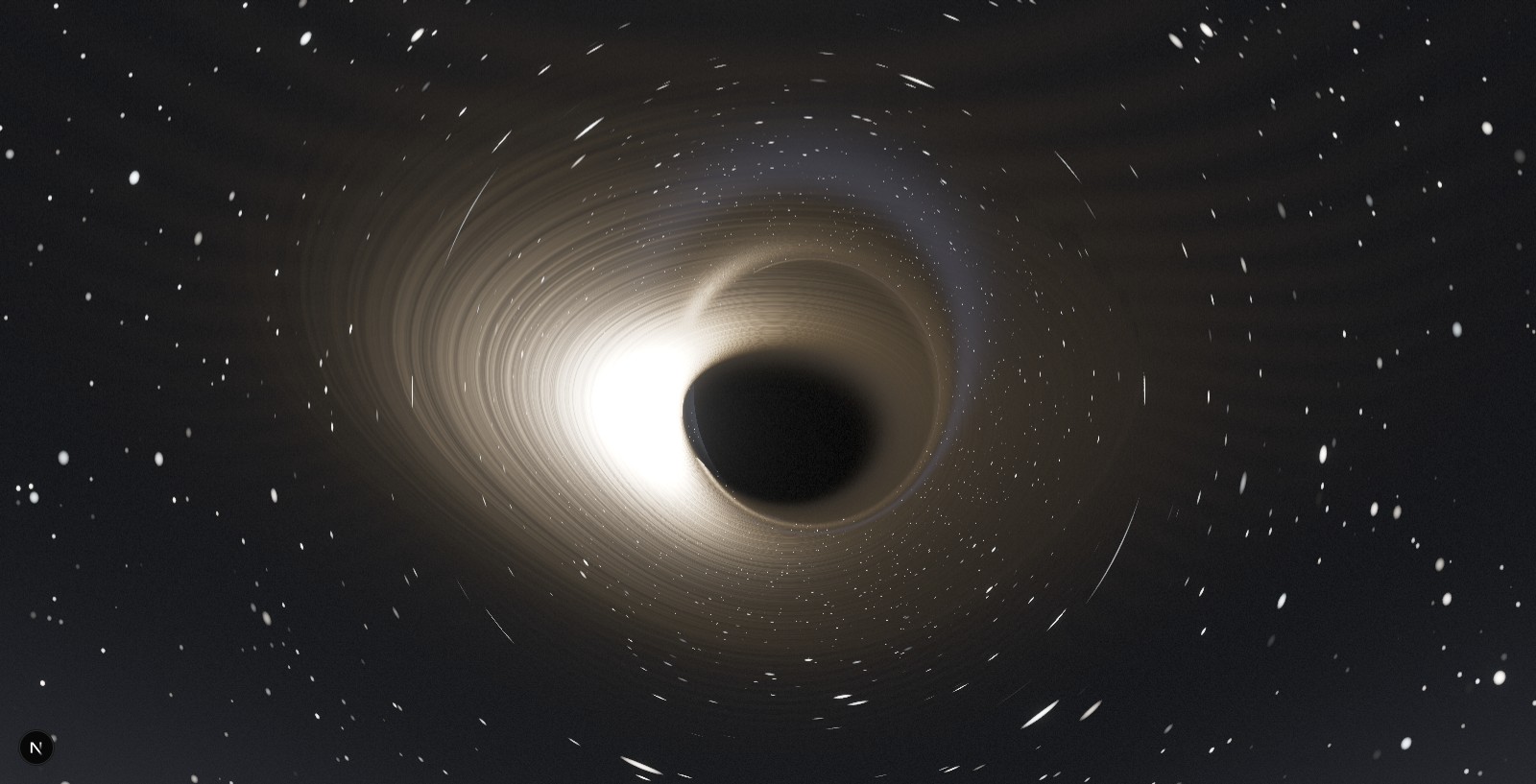
Gargantua, the black hole in Interstellar, is one of the most talked-about sci-fi images ever, partly because behind it there isn't just an artist, but a Nobel-laureate physicist. So: is it real?
Short answer: the physics is real, the image takes a few deliberate liberties. Worth separating them, because they are exactly the choices I had to face building the black hole simulator.
What's true: the Kerr metric
Kip Thorne wrote the equations; the VFX house Double Negative built a dedicated engine, DNGR, and it even produced a scientific paper (James, von Tunzelmann, Franklin & Thorne, 2015). They ray-traced the exact null geodesics of the Kerr metric, the very same physics I run in real time in the browser. The bent light, the shadow, the bright arc above and below (the famous "hat") are not drawn: they emerge from the integration.
The near-extremal spin, and why it matters
Gargantua spins almost maximally: , where is the spin and the physical limit is . It's not an aesthetic flourish, it serves the plot. Spin pulls the innermost stable circular orbit (ISCO), the edge beyond which you can no longer orbit, inward. For a non-spinning hole (Schwarzschild) it sits at ; for a maximally spinning one, prograde, it collapses almost to the horizon:
(the full formula is Bardeen's, 1972). That's what lets Miller's planet orbit so close and survive: without the extreme spin it would already be inside the plunge orbit.
Time dilation: one hour = seven years
The film's central effect. Near a large mass, time runs slower. For an orbiting observer the slowdown relative to someone far away is the factor : the closer you get, the more it tends to zero. On Miller's planet the ratio is about
A factor of sixty-thousand requires sitting a hair's breadth from the horizon of a giant, near-extremal hole: again, it's the spin that makes it possible without being torn apart by tides. In the «Orbits» demo you see the measured speed and the redshift tied to exactly this, and a body appearing to "freeze" at the horizon.
What's cinema (on purpose)
The detail few people know: in the film the disk is almost symmetric in brightness. In reality it isn't. Relativistic Doppler beaming makes the observed intensity scale as the fourth power of the Doppler factor:
A little is enough: the side coming toward us turns blinding, the receding side dims. Nolan and Thorne chose to suppress that asymmetry, because such a lopsided image would have confused the audience. A narrative choice, not a mistake.
And the disk itself? A bespoke artistic-volumetric model built by the artists, not a simulation of magnetised plasma (GRMHD), like ours: full magnetohydrodynamics costs hours per frame. Finally DNGR ran offline, up to hours per frame at IMAX resolution, tracing whole bundles of rays to anti-alias the razor-thin edges. I have one ray per pixel and ~16 milliseconds.
The comparison: reality, cinema, simulator
Before opening the simulator, it's worth seeing what a real black hole actually looks like when photographed.
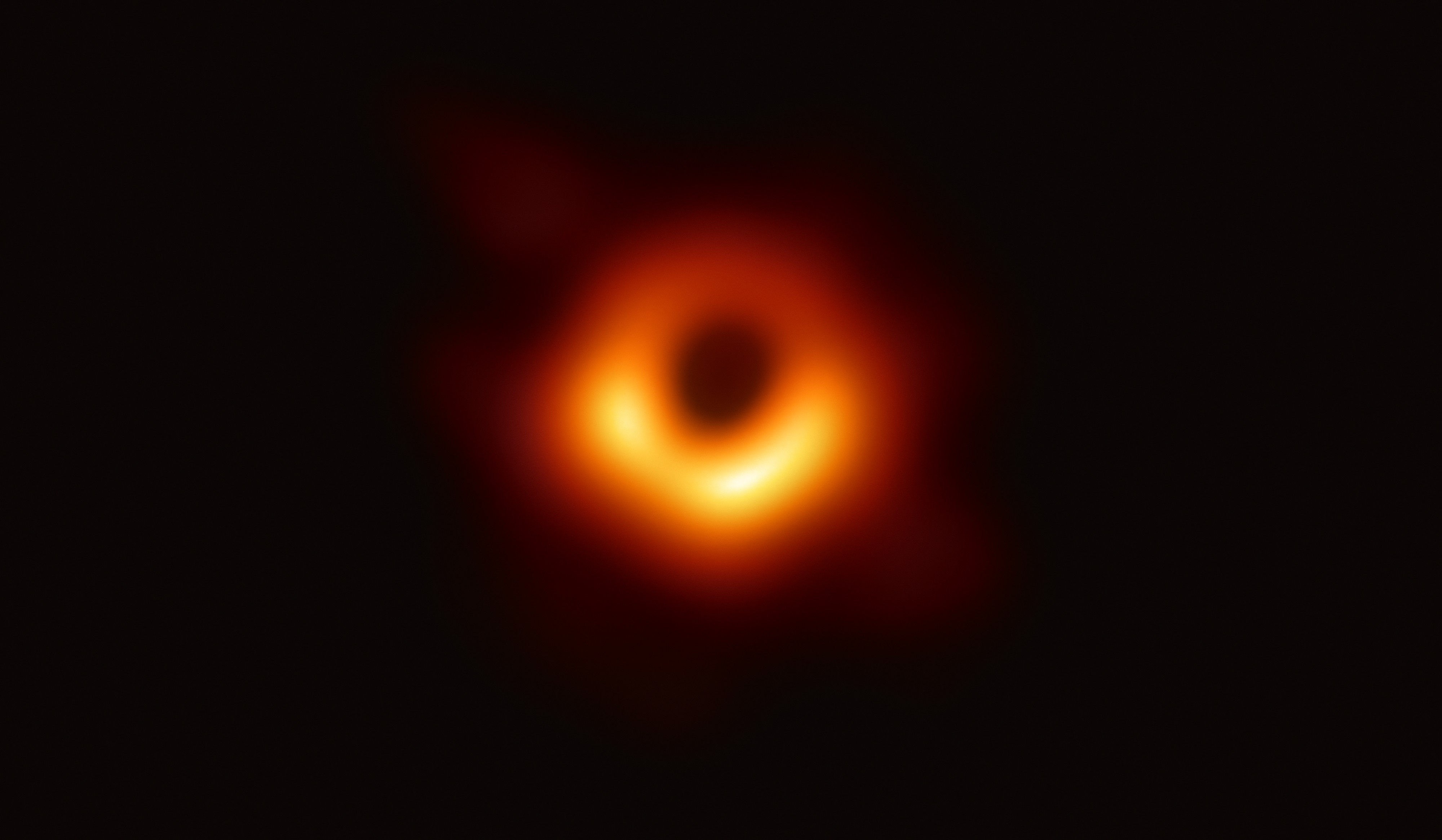 M87*, the supermassive black hole at the centre of galaxy Messier 87, 55 million light-years away. The first direct photograph of a black hole (2019). The bright ring is real: light orbiting the hole before reaching the telescopes. Credit: EHT Collaboration (CC BY 4.0).
The asymmetric ring (brighter at the bottom) is exactly the Doppler beaming that Interstellar suppressed for readability: the plasma approaching us is more luminous. It's the same effect you can toggle in the simulator with the Doppler slider. Gargantua in the film is symmetric because Kip Thorne's team chose it for narrative clarity; reality (and the simulator with Doppler on) is asymmetric.
What you can see for yourself
In the simulator you can do what the film couldn't: turn on the real Doppler asymmetry and watch the disk genuinely lopside; drag the spin slider instead of being stuck on Gargantua, and watch the ISCO and shadow change; orbit the hole in real time. Same Kerr metric, but interactive, and with every approximation declared.
In one line: Interstellar is real physics in service of a story; this is the same physics, laid bare and in your hands.