A real black hole in the browser, in real time
A simulator that computes the black hole rather than drawing it: photon geodesics in curved spacetime, real shadow at 3√3 GM/c², disk at physical temperature.
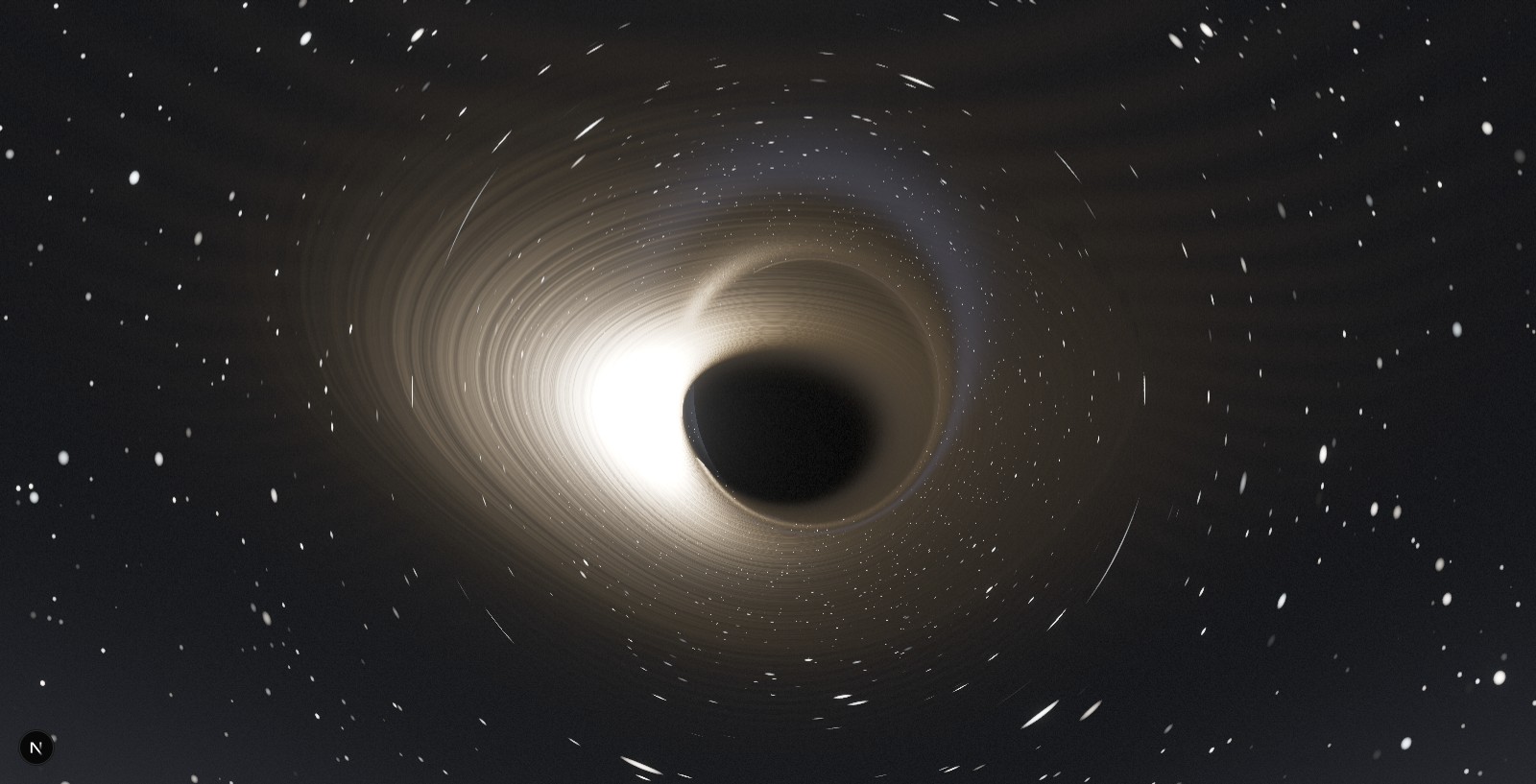
For years I only saw black holes as images: the blurry Event Horizon Telescope photo, Interstellar's Gargantua, the odd render. I wanted something different: a black hole you could touch (rotate, zoom, change) and that was real physics, not a graphical effect. So I built a simulator that runs in real time in the browser.
The simulator: a Kerr black hole running in real time in the browser, with lensed accretion disk, photon ring and relativistic Doppler beaming. The approaching side (left) is hotter and brighter. Render: Fosforonero.
I don't draw it, I compute it
That's the whole difference. For every single pixel I shoot a ray and let it fall through curved spacetime, along the photon's null geodesic. The natural scale is the Schwarzschild radius, the size of the horizon:
For the Sun that would be 3 km, for the Earth 9 mm. Everything else (bent light, the photon sphere, the shadow, the bright ring) emerges from integrating that trajectory; none of it is drawn by hand. It's a simulation of the lensing, not a drawing of it.
The shadow has a precise size
A photon passing close enough never comes back. The threshold is the photon sphere, at (i.e. ), where light can even settle into orbit. Translated into what the eye sees: any ray with impact parameter below a critical value is doomed to fall, and that sets the shadow's radius:
The shadow you see in the centre isn't "the black hole": it's slightly larger than the horizon, because even light that grazes it gets captured. That number comes out of the geometry; I didn't put it in by hand.
The disk glows with the colour of its temperature
The gas spiralling toward the hole heats up by friction. Each ring radiates, and its temperature rises toward the centre:
Every temperature has a true blackbody colour, the same as a poker glowing red, then orange, then blue-white. I convert that temperature to its colour along the Planckian locus and show it: no invented gradient. Then I shift it with the relativistic Doppler effect, and one side of the disk turns blinding, the other dim.
Spin, and the rest
With the Spin slider the black hole rotates: not a trick, the exact Kerr metric ray-traced in real time, the same one as Interstellar's Gargantua, which was rendered offline at hours per frame. The asymmetric shadow and the dragging of space (frame-dragging) appear.
Alongside the main simulation there are two more tools. The Playground lets you throw stars, planets and comets and watch them be torn apart in the tidal field, with gravitational waves and mergers. The Orbits demo integrates the exact relativistic orbits (periastron precession, ISCO) with a live energy-conservation diagnostic. And EHT mode mimics the real Event Horizon Telescope photo.
Honesty first
What's real physics is real physics; what's approximate is declared. The lensing and the orbits are exact; the disk is a model (no full magnetohydrodynamics, that would take hours per frame). The equations page has all the maths with sources, and the FAQ answers the questions everyone asks, from "what happens if you fall in" to "does time really slow down".
No hidden tricks: it's a real black hole, computed pixel by pixel, in your browser.