Spaghettification: a star torn apart by gravity
From tidal force to the t⁻⁵ᐟ³ fallback law: the physics of spaghettification, with equations. What the Playground models and what it doesn't.
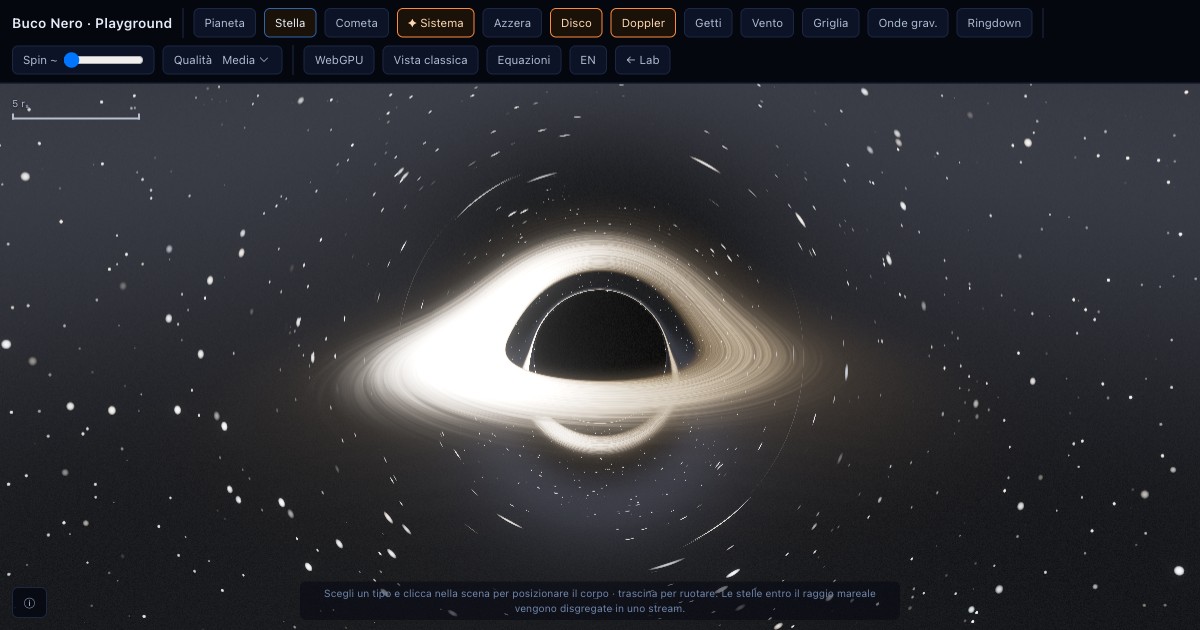
Bring a star close to a black hole and, beyond a certain threshold, it no longer orbits: it gets stretched into a filament of gas and partly devoured. The technical name is a tidal disruption event (TDE); the informal one, attributed to Stephen Hawking, is spaghettification. You can watch it live in the Playground: here I derive the physics underneath, step by step.
Tidal forces: gravity isn't uniform
A tide isn't a new force: it's the difference in gravity between two points of an extended body. The star's near face is closer, hence more strongly pulled, than its far face; that difference stretches it along the line to the hole and squeezes it in the other two directions.
For a body of extent at distance from a mass , the tidal acceleration is the derivative of the gravitational field times :
The heart of everything is that exponent: the tide goes as , far steeper than gravity itself (). Halve the distance and the tide gets eight times stronger. That's why disruption is a threshold phenomenon: negligible far away, explosive up close.
The tidal radius
A star holds itself together with its own gravity. It is disrupted when the hole's tide exceeds its surface self-gravity, which is about . Setting that equal to the tide gives the critical distance, the tidal radius:
Notice what's missing: the two masses enter only as a ratio, raised to one third. The star's density matters; its absolute mass barely does. This weak dependence produces the next, counter-intuitive fact.
Stellar-mass vs supermassive
The bigger the black hole, the "gentler" the disruption. The tidal radius grows slowly, as , but the event horizon grows fast, as (it's ). At some point the horizon overtakes the tidal radius. So:
- around a stellar-mass or intermediate hole, : the star is disrupted well outside the horizon and we see the fireworks;
- around a large enough supermassive one (above ~10⁸ solar masses), : the star crosses the horizon whole, swallowed with no show.
There's a sweet spot of masses (million-solar-mass holes like Sgr A*) where disruption happens just outside the horizon and is observable.
The energy spread: half returns, half escapes
At the moment of breakup the star has a single orbital energy, but its pieces don't: the side near the hole is more tightly bound, the far side less. This spread in specific energy across the debris is the key mechanism (Rees 1988). Its scale is the tide times the star's size:
About half the debris ends up with negative energy (bound) and falls back toward the hole; the other half with positive energy (unbound) is flung out in a long tail. In the Playground that's exactly the split I colour: one arm that returns and feeds the disk, one that escapes.
The t⁻⁵ᐟ³ fallback law
This is the phenomenon's most elegant result. The bound debris returns on Keplerian orbits, and the most bound returns first. The return time of debris with energy follows Kepler's third law:
If the mass is spread roughly uniformly in energy (, Rees's assumption), the rate at which gas falls back onto the hole is the chain rule:
That slope is the observational signature of real TDEs: the flares telescopes see brighten and then fade over months track that very curve. It's one of the few clean predictions of an otherwise chaotic event.
What the Playground does (and doesn't)
The simulation doesn't solve the gas hydrodynamics, that would be a supercomputer job. It uses a particle model on top of the Paczyński–Wiita pseudo-Newtonian potential:
That in the denominator is a neat trick: it reproduces the ISCO at and the final plunge (the strong-field effects Newton lacks) while staying light enough to run in real time with dozens of bodies.
When a star enters the tidal radius, I dissolve it into debris with the energy spread above: half falls back and feeds the disk, half escapes. The breakup is gradual (about half a second, not instantaneous) and the star's mass drains away as it is devoured, so its pull on the other bodies fades realistically. What's not there: the shocks, the compression heating at periastron, the true fluid dynamics. It's an honest dynamical model, not a hydrodynamic solution.
The numerical details and the other approximations are on the equations page. Sources: Hills (1975) and Rees (1988) for the disruption and the law; Paczyński & Wiita (1980) for the potential.